
From spreadsheet to taxonomy in minutes
Upload your CSV or XLSX. Structera proposes a 3-level taxonomy you can review and edit before any classification runs.
Upload a CSV of transactions. Structera proposes a 3-level taxonomy anchored to the global procurement standards (see below), classifies a sample for free, and lets you review and refine before applying to your full dataset.
Sample classification is always free. You only pay when you apply to your full dataset.
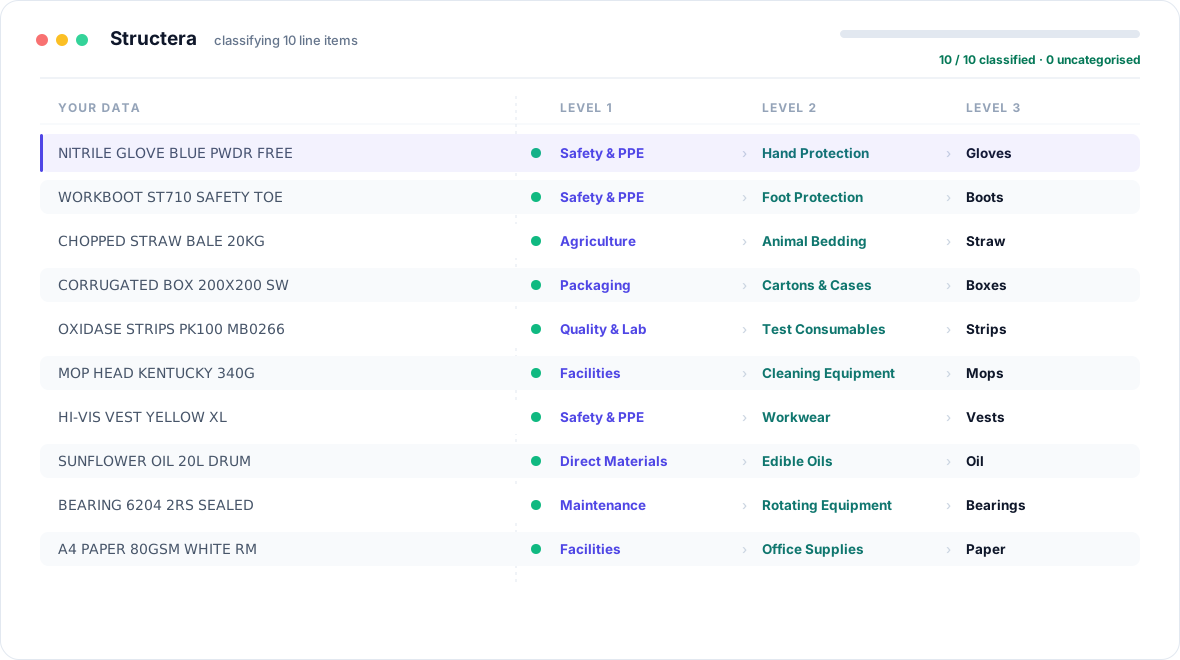
Classification work that used to take weeks, done in minutes — with audit-trail-ready Excel output.
Upload your CSV or XLSX. Structera proposes a 3-level taxonomy you can review and edit before any classification runs.
Eighteen universal top-level towers apply across manufacturing, retail, services, healthcare, tech, agriculture, and public sector — so your spend cube is benchmark-comparable from day one.
A statistically valid sample is classified for free, so you can validate accuracy before committing budget. Each account gets one free sample per data type (suppliers, materials, services) — three free trials in total.
Low-confidence rows surface for review. Each override is remembered per-supplier, so the same vendor classifies the same way next month with no repeat processing.
Parallel processing plus normalised-text deduplication mean 1,000 rows classify in under a minute.
One-click .xlsx export including a procurement-consultant insight pack: executive summary, category analysis, top suppliers, rationalisation opportunities, tail spend, and a prioritised quick-wins playbook. Drops straight into Power BI / Tableau / Looker.
Five steps from raw transactions to a categorised, exportable dataset.
CSV or XLSX up to 25 MB. Supplier / material / service data modes.
3-level structure anchored to UNSPSC, SIC, NAICS, NACE. Edit inline.
~100 representative rows tagged automatically in seconds.
Approve, override, or correct. Overrides teach per-supplier memory.
Pay once, classify the whole dataset, download the Excel workbook.
Steps 1–4 are free on your first workspace of each data type. Step 5 is pay-as-you-go.
Sample classification and taxonomy generation are always free. You only pay when you apply classifications to your full dataset or export it.
Worked examples: 10,000 rows = £175. 100,000 rows = £1,275. 1,000,000 rows = £10,275.
Sample classification, taxonomy generation, and review are always free. No card required to start. You see exactly how your data is categorised, on your own data, before any payment is taken — so you only pay once you already know the output is worth it.
Most rows are classified with high confidence, with every leaf category mapped to a global standard (UNSPSC, with NAICS / SIC / NACE cross-references). Low-confidence rows surface in a dedicated review queue so you can correct them quickly. Each override is remembered, so accuracy compounds with use.
CSV and Excel (.xlsx). Download the template from inside the app to see the exact column shape — supplier name, description, amount, date.
Your transactions live in your own isolated workspace. Other users can't see your companies. Transaction text is processed by our automated classification system and sent to our sub-processors; see our Privacy Policy for the sub-processor list, data flows, and safeguards.
Yes. Every level is editable inline in the app. You can rename categories, add new ones, or delete categories that don't fit. Changes wipe stale classifications so the next run reflects your taxonomy exactly.
GBP 25 minimum. Then GBP 20 per 1,000 rows for the first 5,000; GBP 15 per 1,000 from 5,001 to 50,000; GBP 10 per 1,000 above that. Sample classification is always free.
No. Structera runs entirely in your browser. Sign up, upload, classify.
Every paid export ships with a procurement-consultant insight pack: an executive summary, a Level 1 category analysis with strategic recommendations, the top 20 suppliers with action notes, supplier rationalisation candidates with estimated savings ranges, a tail-spend analysis, and a prioritised quick-wins playbook. The pack is included in the pay-as-you-go price — no separate consulting fee.
Procurement spend classification (also called spend categorisation or spend categorization) is the process of taking every line item in your procurement data — supplier invoices, purchase orders, expense lines — and assigning it to a category in a structured taxonomy. It's the foundation of any spend analytics programme: until your spend is classified, you can't answer the basic questions about spend visibility like “how much did we spend on IT software last quarter?” or “which suppliers are we paying twice for the same service?”
Done manually, classification can take weeks of analyst time. Most teams end up with inconsistent categories, untreated tail spend, and a taxonomy that drifts between business units. Structera automates the work: the system reads each transaction and proposes a 3-level taxonomy anchored to the global procurement standards — every Level 1 tower maps to UNSPSC standard (with NAICS, SIC, and NACE cross-references), and a statistically representative sample is classified for free before you commit to a full run. Reviewing the sample takes minutes, and corrections train per-supplier memory so the next run is faster, cheaper, and more accurate.
How classification works. Structera categorises your data using automated systems, including machine-learning models. Results are proposed, not final: you review a free sample and can override any row before applying to your full dataset, and every override is kept. No automated decision is made about any individual. See our Privacy Policy for the sub-processor list and data flows.
Whether you're running a one-off spend cube for a board paper, evaluating indirect spend reduction opportunities, mapping a legacy ERP taxonomy onto a modern one, or feeding clean data into Power BI / Tableau / Looker, Structera gets you from raw spreadsheet to classified dataset in minutes. See the workflow or browse the procurement glossary for definitions of related terms. Pricing is pay-as-you-go from GBP 25 — no subscription, no seat fees, no commitment.
Upload your first dataset in under five minutes. The sample is free.